Vaccaj: Exercise 10a
Listen to the recording
Sheet music
Lyrics
Introduzione al gruppetto
Introduction to turns
their love is innocent and
pure, not weakness.
Performance instructions
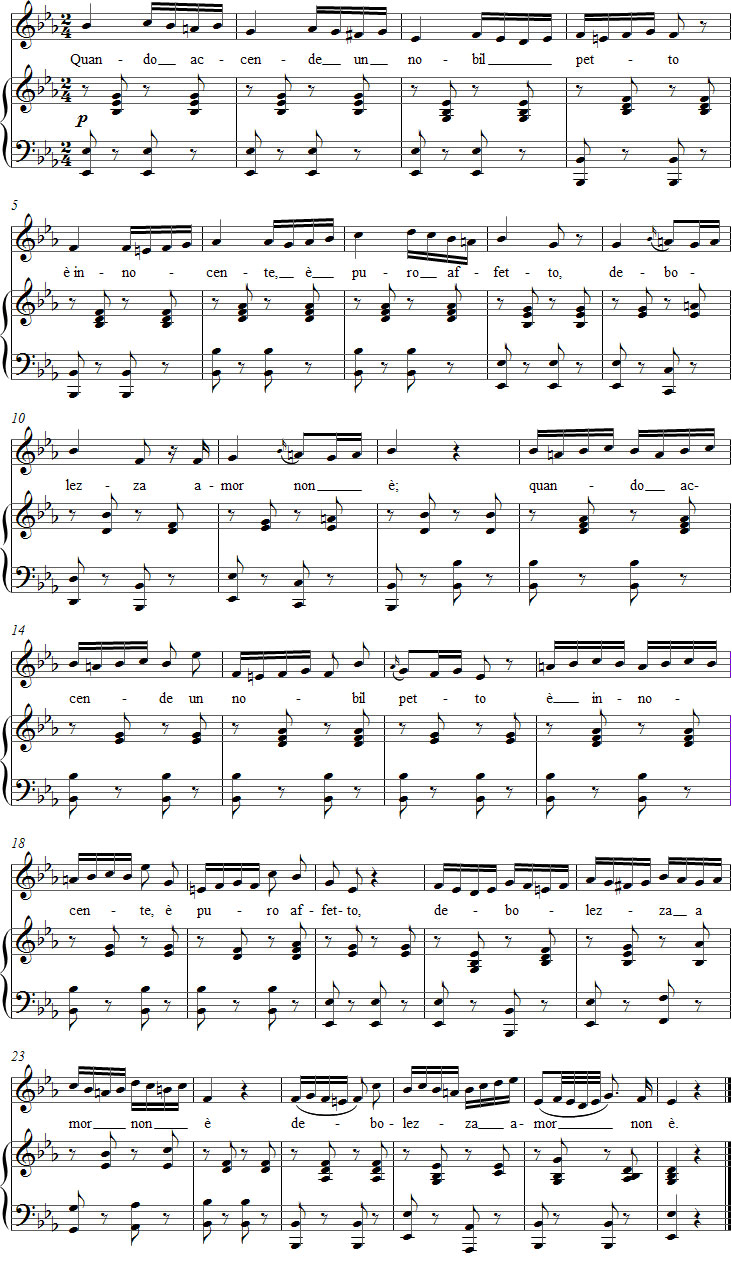
This exercise practises turns (25 in total), which are accented when they fall on a strong beat and unaccented elsewhere. Bar 27 also contains a variation in which the ornamental notes follow their principal note. This type of ornament is the actual subject of Exercise 10b.
Vaccaj wrote out the turns as sixteenth notes, but students can also familiarise themselves with the traditional notation used in place of the sixteenth-note figures in the score.
In bars 9, 11 and 16, the first note of the figure has the same accentuation as an appoggiatura. The note is produced in the same way as in the figure written out as four sixteenth notes.
Iffert describes the turn as a three-note ornament in which the notes occur in the order: upper second – principal note – lower second, or the reverse. The ornament usually spans a minor third and can be performed in several different ways. For example, the figure beginning from above, with the principal note as its second and fourth notes, appears in bars 1, 2, 3, 9, 11, 16, 21, 22 and 23. The figure beginning from below occurs in bars 17, 18 and 19.
A variation of the turn, also known as a "roll" or "Külterbüchse" (a term originating in military history), occurs in early music. In this variation, the principal note appears as the first and third notes. The descending form occurs in bars 4, 5, 6, 13, 14 and 15. The ascending form occurs in bars 25 and 26.
Metastasio conceived this poem as a duet from the outset. That is why it has only three lines.
Practice suggestions
When learning this song, first identify its underlying melodic outline. Here is a suggested version:
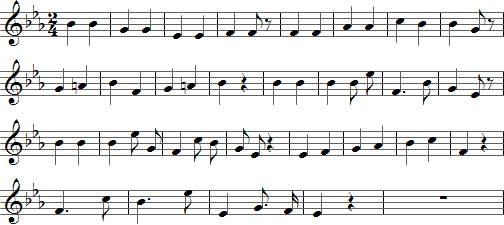
You will soon notice that the monotonous, angular melody needs ornamentation. Try improvising gruppetto figures to embellish it.
At first, sing Vaccaj's notated melody on one or more vowels only. Articulation should be light, but the first note must be both lengthened and accented, except in bars 5 and 6, where the first sixteenth note of the turn is the same pitch as the preceding note.
When practising slowly and thoughtfully, you will appreciate the value of the notation. It is also worth reading the text alone at a relaxed tempo. Gradually increase the speed and sing the melody both with and without the words. At the same time, you will need to increase the energy of articulation in the turns.
Ideas for interpretation
The melodic outline fits the text relatively well and requires adjustments on the first beats only in bars 5, 9, 17, 21 and 25. It seems impossible, however, to accent the first note of every turn while simultaneously maintaining natural word stress. It is probably wiser to preserve rhythmic vitality at the expense of the text's prosody.
The word accende may have inspired Vaccaj to choose this particular text for the preparatory exercise on turns. According to a saying, the ornament can set its principal note ablaze.
Be moderate when choosing the tempo. Singing more slowly allows the sixteenth notes to be expressed with greater intensity. At an Allegro tempo, the song can easily become rather bland.
Forshufvud, G. 1994. Con lieve fiato. Lärarhandledning till Nicola Vaccajs Metodo pratico. Göteborgs universitetet.