Vaccaj: Exercise 12
Listen to the recording
Sheet music
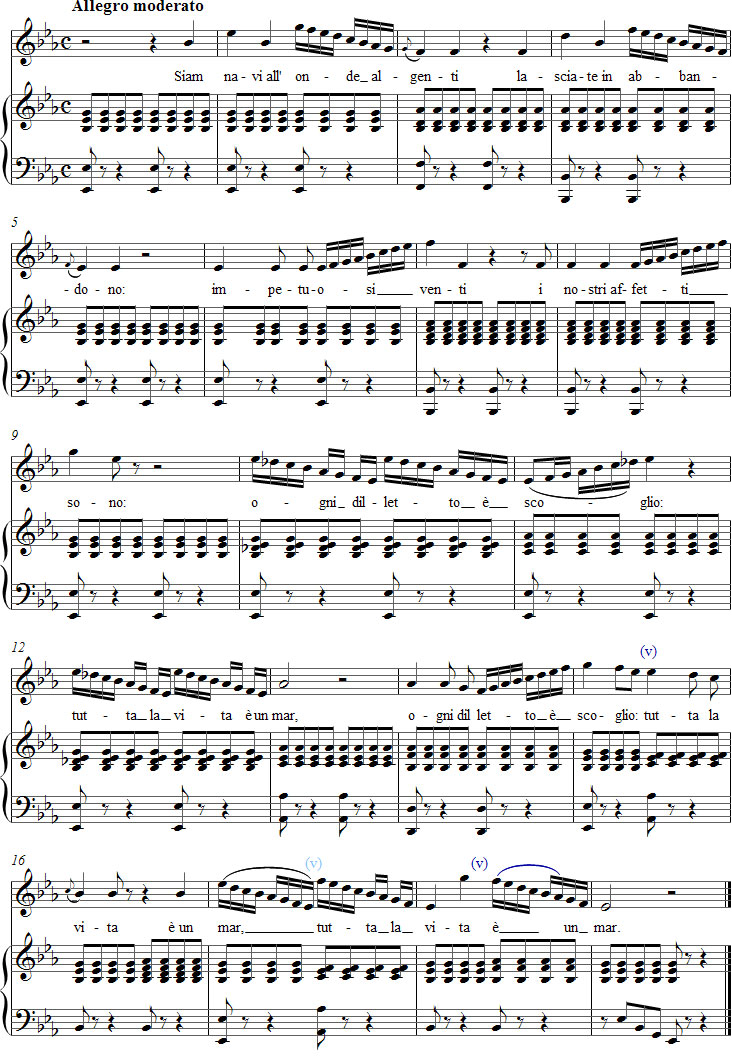
Lyrics
Le volate
Introduction to roulades
ships on a freezing sea.
Our emotions are rough winds.
Every joy is a rock in the sea.
Life is an ocean.
Performance instructions
This exercise is a continuation of the song Come il candore (Exercise 7). Vaccaj has chosen a dramatic, stormy poem about the sea and wind. The song is full of runs (volate) and ascending and descending leaps. It even gives the student an opportunity to attempt a tenth. The exercise should be sung fearlessly and powerfully, using coloratura di bravura, or even coloratura di forza, so-called "power coloratura".
The varying stresses of the seven-syllable verse receive an exemplary musical setting in this exercise. This is evident, among other things, in the emphasis on the first syllable of abbandono and impetuosi.
Practice suggestions
Begin practising at a restrained tempo (eighth note approximately M.M. 112). Vary the articulation, mainly on the vowel a.
- Begin with a gentle legato at a piano dynamic.
- Then lightly accent every fourth sixteenth note.
- Try articulating the sixteenth-note figure in groups of 2 + 2. Accent the first note of each group.
- Next, separate all the sixteenth notes with a light marcato.
- Gradually increase the vocal intensity to forte. Emphasise the text more strongly.
Read the text in a "theatrical voice" to the pulse of the composition, expansively and without inhibition. Once the words feel familiar in speech, combine them with the melody. You can now repeat the steps above with the words.
Practising the tenth becomes technically easier through syncopation: sing the first note of the interval as an eighth note and the second as a dotted quarter note. This also helps with placing the accent on the latter note. If singing the tenth feels difficult, return to bar 15 of the previous exercise, where you probably sang the same interval without difficulty by means of the intervening octave. In this exercise, too, you can try occasionally adding an octave before the tenth.
Breathe before the final run and, if necessary, also before tutta in bar 15. Take enough time; you can even shorten the syllable tut- to an eighth note and the syllables -ta and la to sixteenth notes.
Increase the tempo gradually, but only as far as the vocal power and clarity of the runs can be maintained.
You can experiment with replacing sempre forte with a crescendo in ascending runs and a diminuendo in descending runs.
The run at the end of the penultimate bar is generally sung as in the recordings, although Vaccaj's own intention was probably to divide the final two quarter notes into 6 + 2.
Ideas for interpretation
The drama of the song brings many unstressed syllables to the fore, even though Vaccaj respects the prosody of the poem. This is familiar from opera, where the voice must carry over the orchestra regardless of the text. One way to avoid misplaced stresses is to give an unstressed syllable the first six sixteenth notes instead of four, as happens in bar 18. Ideally, the singer would be able to accent the musical notes without simultaneously adding emphasis to the vowels and consonants of the text.
Forshufvud, G. 1994. Con lieve fiato. Lärarhandledning till Nicola Vaccajs Metodo pratico. Göteborgs universitetet.