Vaccaj: Exercise 14
Listen to the recording
Sheet music
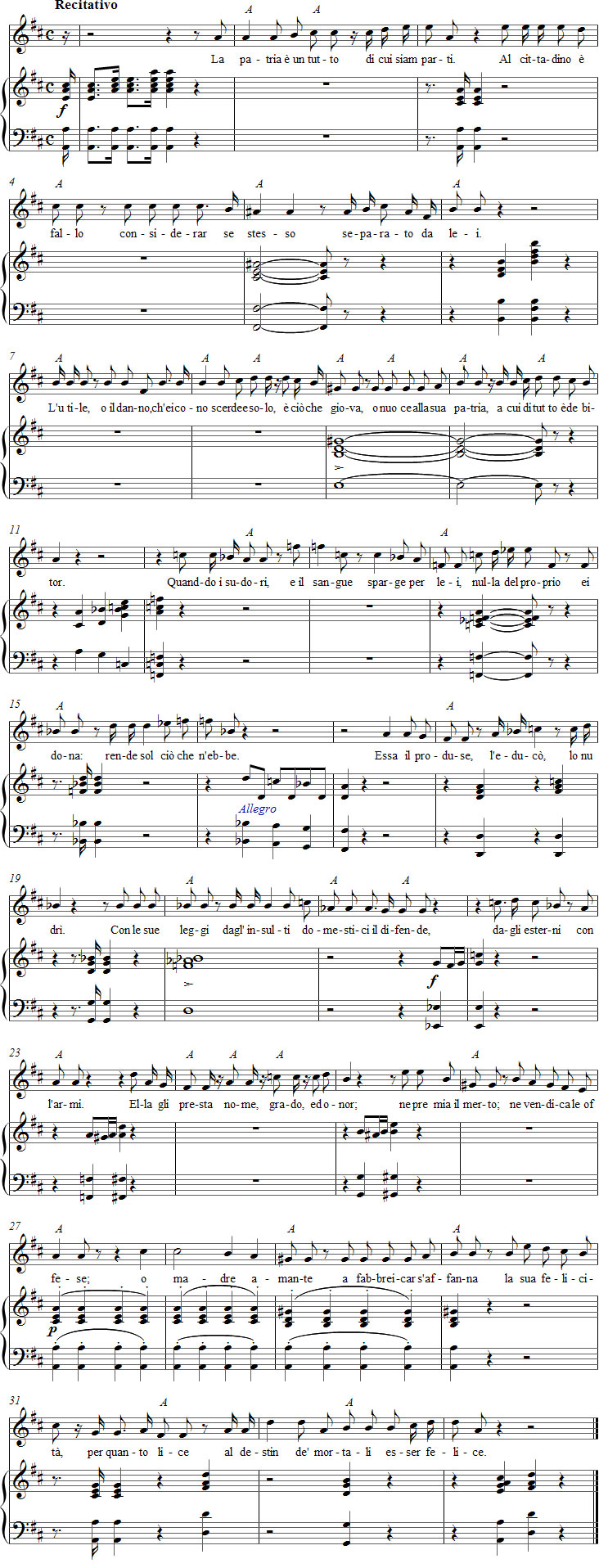
Lyrics
Il recitativo
The recitative
which we are part of.
It is mistake for a citizen
to see himself as separate from it.
He must not know
other benefit or loss
than all
that helps or harms
his fatherland,
to which he owns everything.
When he sweats or sheds blood for it,
he is not giving away anything of his own;
he just returns what he received.
Fatherland produced him,
educated him, nourished him.
It defends him from domestic insults with laws
and from foreign insults with armies.
It lends him a name,
a rank and honour, awards him for merits
, avenges him, and like a loving mother toils
for his happiness
inasmuch as
happiness is the fate of mortals.
Performance instructions
This exercise focuses on recitative. The aim is to understand the words and their meaning and communicate them clearly to the audience.
In Metastasio's poem, the speaker is a hero named Atilius Regulus, who impresses with his magnificent bearing without appearing ostentatious. He is thoughtful by nature and has authority, yet is also friendly and restrained. Atilius Regulus tries to convince his son that sacrificing one's life for one's country is supremely honourable.
Practice suggestions
Despite the large amount of text, the correct pronunciation of every word must become firmly established, as must its proper understanding. It may therefore be sensible to divide the exercise into three parts. It is best to begin with the first 11 bars, then continue with the final six bars, and hope that the singing student will be interested in the bars between them.
Try the following approach:
- Take Vaccaj's phrasing as the starting point and read the text in a normal speaking voice, practising the correct word stresses.
- "Speak-sing" the text in the same dry manner, following its "melody" but omitting all the grace notes.
- Read the text again in a grand, declamatory theatrical voice. Notice how this may lead to the appoggiatura shown in the score, including the grace notes "composed into" the music.
- Notice, too, that this is the bridge that helps the singer connect speech and singing. According to the Paris Conservatoire's school of singing, recitative requires constant concentration on singing and speaking at the same time; the two activities must never be separated.
- Finally, practise "singing" in a theatrical voice just a little, then perform the entire recitative in that manner, with all its appoggiaturas.
Ideas for interpretation
The tempo of both speech and singing must be calm enough that the shortness of the phrases does not seem unjustified. One may recall Belgiojoso, according to whom serious recitatives should be performed nobly, with grand style and deep feeling. (Buffo recitatives, by contrast, should be light, lively and exuberant.) He agrees with Hauser that the singer must identify with the dramatic situation in order to deliver the recitative correctly.
When "singing", however, the tempo must not be so slow that the performance slips into pure singing. An exception is the phrase e madre amante in bars 27–29, which is an arioso within the recitative.
To dare to combine the normal singing voice with "speech", the singer must have a very clear understanding of the melody.
The note following a grace note must neither be accented nor lengthened.
Forshufvud, G. 1994. Con lieve fiato. Lärarhandledning till Nicola Vaccajs Metodo pratico. Göteborgs universitetet.