Vaccaj: Exercise 1a
Listen to the recording
Sheet music
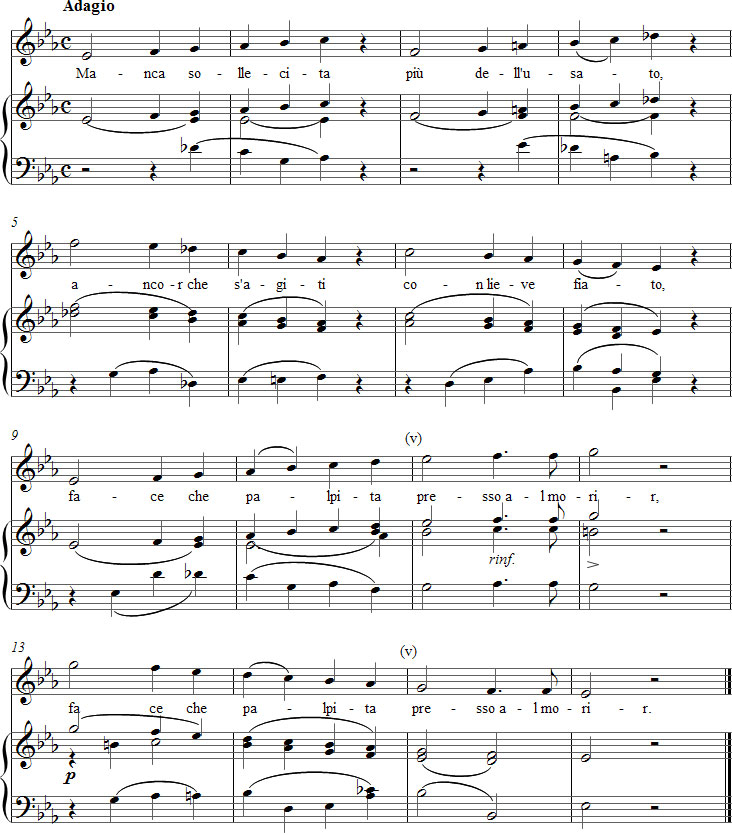
Lyrics
La scala
The scale
and dies unexpectedly
even though
the wind is light
Performance instructions
This exercise focuses on intervals of a second and scales. The song is a solfège exercise, but it also serves as an introduction to practising legato.
At the beginning of the exercise (bars 1–2 and 3–4), there are two ascending six-note scales, or hexachords, followed by their inversions. To demonstrate that the exercise should be sung sempre legato, Vaccaj divided the words so that all syllables are open, meaning that they end in a vowel and any final consonant of a syllable is attached to the beginning of the next syllable.
The lines of the poem have five syllables. The primary stress falls on the fourth syllable, with a secondary stress on the first or second. The rhythmic structure of the melody suits lines 1, 2, 5 and 6. In fact, lines 1, 3 and 5 of the poem contain six syllables, which provides a good basis for the opening hexachord. However, this requires the second and fourth phrases to be completed with a melisma in order to preserve the melodic idea. A melisma is also needed on the word palpita so that the text fits the scale.
Practice suggestions
The melodic structure of the first exercise and the tempo marking adagio place considerable demands on the singer. The word stresses in the text and the particularly troublesome vowel i in bar 12 add to the difficulty. It is therefore important to allow time for preliminary work, which makes it easier to combine the poem with the melody.
An excellent way to prepare for singing the exercise is to work with syllables such as no, vo, la and le. Although Vaccaj intended his singing method to offer an alternative to traditional solfège exercises, familiar solfège syllables, which provide a variety of vowel and consonant sounds, can also be used in practice. All the syllables, except sol, are open. You can therefore sing the exercise as follows:
do - re - mi - fa - sol - la
re - mi - fa - sol - la - si
re2 - do2 - si - la - sol - fa
la - sol - fa - mi - re - do
do - re - mi - fa - sol - la - si - do2 - re2 - re2 - mi2
mi2 re2 do2 - si - la - sol - fa - mi - re - re - do
In Italian, the vowels in syllables such as do and re are inherently open in quality, but better (higher) vocal placement is often achieved by singing them as closed vowels. You can emphasise the legato sensation by singing melismatically.
Correct pronunciation and thorough understanding of Metastasio's text are essential. Reading the text can be practised, for example, through "legato reading".
In the last two phrases, after the word palpita, it often feels as though there is not enough time to breathe. However, it is quite possible to enter slightly late on the first note of bars 11 and 15.
When two vowels meet (two syllables on the same note), as in -so al (bars 11 and 15), the vowel a should be given almost the entire note value.
The high note in bar 12 often sounds forced, and the accents in bars 11 and 12 do not make matters easier. Young male voices can therefore use diminuendo and falsetto to reach the note mi. On the first note of bar 13, the vowel a may make it possible to produce an effective full voice.
The pianist can help an uncertain singer in bar 2 by adding the notes sol-fa-mi as an eighth-note triplet on the last quarter-note beat. In bar 4, do2 can be played, and in bar 6, sol can be played on the last quarter-note beat. Gradually, the pianist should stop playing the melody altogether.
Ideas for interpretation
Morir is the central word of the poem and should be the starting point for interpreting the meaning of the text. For this reason, too, the accent in bar 11 should be restrained. The unstressed preposition con must also be kept under control (bar 7).
Thinking in larger metrical units, which means avoiding an emphasis on the first beats of odd-numbered bars, is often a good solution.
Forshufvud, G. 1994. Con lieve fiato. Lärarhandledning till Nicola Vaccajs Metodo pratico. Göteborgs universitetet.