Vaccaj: Exercise 2a
Listen to the recording
Sheet music
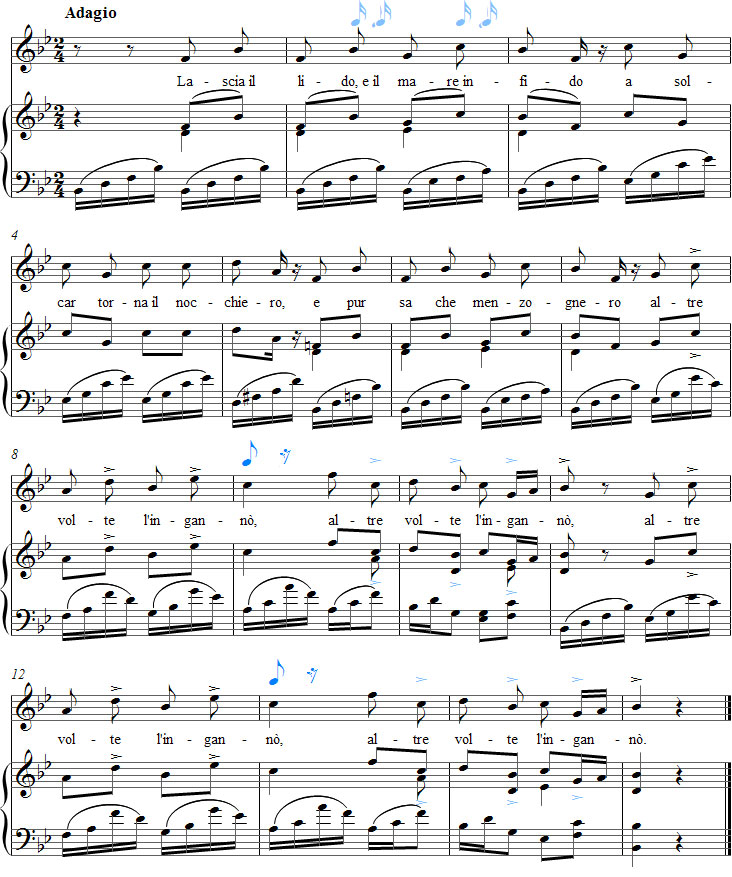
Lyrics
Intervalli di quarta
Fourth intervals
ploughs the treacherous
waves again knowing that the sea has
betrayed him before.
Performance instructions
This exercise focuses on the interval of a fourth, which is relatively easy to find but difficult to sing smoothly. The angular nature of the interval requires conscious control of the airflow when aiming to sing it legato.
There are two versions of this exercise originating from Vaccaj himself. The Ricordi and Peters editions, among others, include accents in phrases 4 and 6, whereas the Boosey and Paton versions do not. The methods used to practise the song may vary depending on the version being used.
The text about the sea chosen by Vaccaj suits the character of the interval of a fourth. Every phrase of the song begins in the middle of a bar, and the final phrase is repeated three times. In the first phrase, Vaccaj follows Metastasio's text, but after that an interesting contrast emerges. For example, Vaccaj does not accentuate the words a and e. The stress belonging to the first syllable of torna is also disregarded.
The discrepancy in the piano part in bars 10 and 14 is not a mistake.
Practice suggestions
An inexperienced student can try filling in the leaps of a fourth with notes from the scale, in a manner of improvisation. A slow tempo helps, as does the student's intense concentration. Vaccaj may have considered that singing the first three phrases with concentrated legato was sufficient. In the accented version, from the fourth phrase onwards, the student can relax and move to an emphasised and straightforward non legato. In the latter part of the song, the student can thus demonstrate the ability to sing fourths directly and confidently.
In the unaccented version, the added intermediate notes can be omitted, and the focus can instead be placed on singing legatissimo.
Beginning with this third song in the singing method, Vaccaj divides words into syllables in the traditional way. Nevertheless, it is still useful to think of the syllables as open.
You can work, for example, with the syllables va-vi or va-vo. The more closed quality of the second syllable can help prevent an unintended increase in volume on an ascending fourth. For descending fourths, you can sing vi-va, for example, which will probably produce a natural accentuation of the eighth notes.
In bars 9 and 13 of the vocal part, an eighth-note rest can be marked on the second eighth note, as Vaccaj himself did in bar 11. The final vowel of the word l'ingannò is, of course, stressed but short.
When singing at a slow tempo, the phrases require so much air that a fermata can very well be placed at every breathing pause.
The word altre is one of the words in Metodo pratico that contains three consecutive consonants. It must therefore be articulated with a reasonable amount of energy.
The pianist should move to accompanying with the left hand only as soon as possible.
The singer can emphasise accented notes by allowing them to begin a sixteenth note early.
It may be useful occasionally to try singing the entire exercise with exaggerated portamento (as in Exercise 13a). For variety, portamento di sotto can be tried in phrases 4 and 6 (see Exercise 13b).
Ideas for interpretation
One reason for singing accents on the weaker parts of the beat could be the shock caused by the sea's treacherous behaviour, or an attempt to depict a stormy sea. Already in the second line of the poem, a sense of "fear" is encountered by stressing the final syllable of torna. This is a necessary consequence of the fact that Italian poetry does not accept two consecutive stresses. Therefore, the final syllable of solcar cannot be stressed immediately before the first syllable of torna.
Regardless of the version, the tempo should be slow enough to create an impression of reluctance to leave the land behind. In the unaccented version, the last four phrases provide an excellent opportunity to practise different nuances of expression.
Other notes
Accents on weaker beats occur relatively frequently in the Italian canzone style, for example in Santa Lucia. They were also used by Rossini and Bellini, among others (compare Ch'io mai vi possa, set to a text by Metastasio, in Rossini's Soirées musicales).
Forshufvud, G. 1994. Con lieve fiato. Lärarhandledning till Nicola Vaccajs Metodo pratico. Göteborgs universitetet.