Vaccaj: Exercise 2b
Listen to the recording
Sheet music
Lyrics
Intervalli di quinta
Fifth intervals
comfort, I am scared of the sea
in the harbour.
Performance instructions
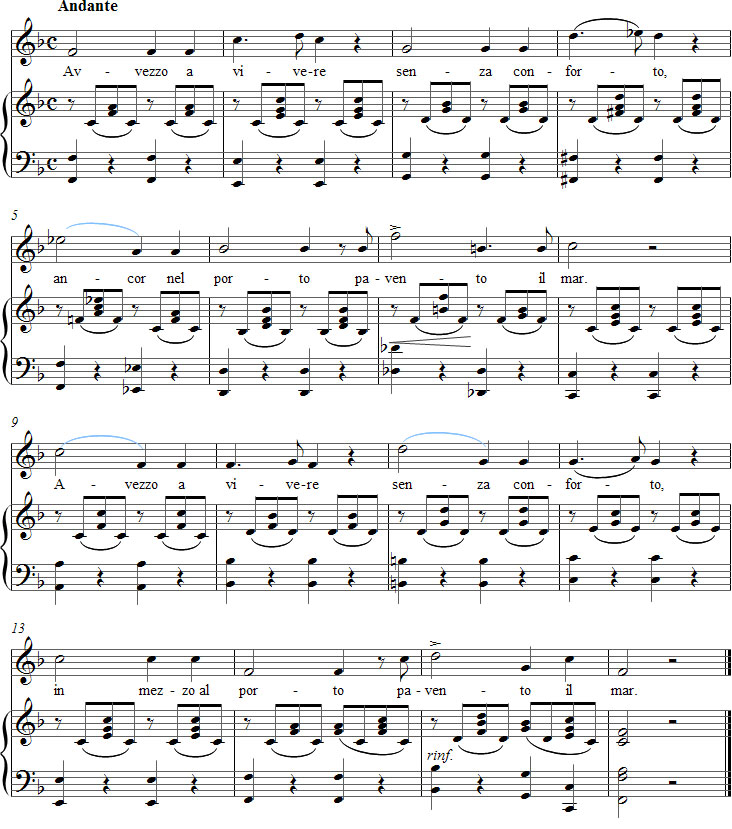
This exercise introduces the interval of a fifth, which Vaccaj provides ten opportunities to practise over the song's 16 bars. The half notes and dotted quarter notes are also suitable for practising messa di voce (gradually swelling and diminishing the sound).
Most of the secondary stresses in the five-syllable lines of the poem fall on the second syllable. One might have expected this to inspire Vaccaj to begin the song with an upbeat, but he is not afraid to allow the music and poetry to conflict already in the first phrase. Only in the final line of the poem, that is, in the fourth and eighth phrases, does the melody adapt to the text, while also protecting the word pavento from a "Finnish-style" stress pattern.
Practice suggestions
For the first time in Metodo pratico, the piano accompaniment in this exercise does not double the melody. The singer therefore has a good opportunity to explore fifths, for example by using thirds and notes from the scale. Since the first note in several leaps of a fifth is a half note, it can be divided into two quarter notes or four eighth notes. The melody can then take the following form, for example:
re - re - fa - la - si - la
mi - mi - sol - si - do2 - si
do2 - si - la - sol - fa - fa - sol - sol
sol - re2 - sol - sol - la
la - sol - fa - mi - re - re - re - mi - re
si - la - sol - fa - mi - mi - mi - fa - mi
la - la - fa - re - re
la - si - mi - la - sol - fa - mi - re

The word paventi may be the key to the choice of text. To give the student an opportunity to practise the "nasty" diminished fifth, or tritone, a word with a negative meaning is needed to justify it.
The melismas in bars 4 and 12 attempt to carry the legato naturally into the leap of a fifth.
On the half notes, the consonants should be sung as late as possible. Otherwise, there is a risk of allowing nasal consonants to become excessively prolonged.
A slow andante tempo forces the student to sustain the phrase. The breath pressure must be so flexible (lieve) that an ascending fifth does not cause unintended accents on the eighth notes in bars 2, 4, 10 and 12. Practising messa di voce on the dotted quarter notes helps to establish the correct singing technique.
By changing the text to pavento il, Vaccaj assigns different vowels to different notes. In this way, among other things, he creates a leap of a fifth between the final two bars on both occasions.
Occasionally sing la-si-la in bar 13 to improve the word stress.
Ideas for interpretation
The final line of the recitative preceding this aria in the opera Demetrio is Dubito ancora, meaning "I still doubt." The seriousness underlying the song may explain the choice of a deliberate tempo.
To make the poetry and music blend together, the energy must be directed towards the final stressed syllable of the phrase. For example, the accent in the word pavento must not be so strong that the final word of the poem, mar, is overlooked. Correct phrasing will also naturally reveal that conforto and porto belong together and rhyme.
Gradually introduce a light portamento in bars 5, 9 and 11. The accents in bars 7 and 15 can provide a contrast to this kind of "gliding."
Almost all the half notes can be ornamented with turns or mordents. Occasionally, also try double-dotting the rhythms in bars 2, 4, 7, 10 and 12.
You can change the half notes in bars 6 and 14 into the same figures as those in bars 4 and 12.
Challenge yourself by singing with tempo rubato.
The pianist should maintain a light and spacious accompaniment, even at a slow tempo.
Other notes
Vaccaj originally used a four-line poem, whose third line is ancor nel porto, not in mezzo al. Later, publishers changed and added to the text, resulting in different versions being circulated. As a compromise, the sheet music used here contains both variants: ancor... in bar 5 and in mezzo... in bar 13. Differences can also be heard in the vocal recordings, depending on which publisher's edition the singer used when practising.
Forshufvud, G. 1994. Con lieve fiato. Lärarhandledning till Nicola Vaccajs Metodo pratico. Göteborgs universitetet.