Vaccaj: Exercise 4b
Listen to the recording
Sheet music
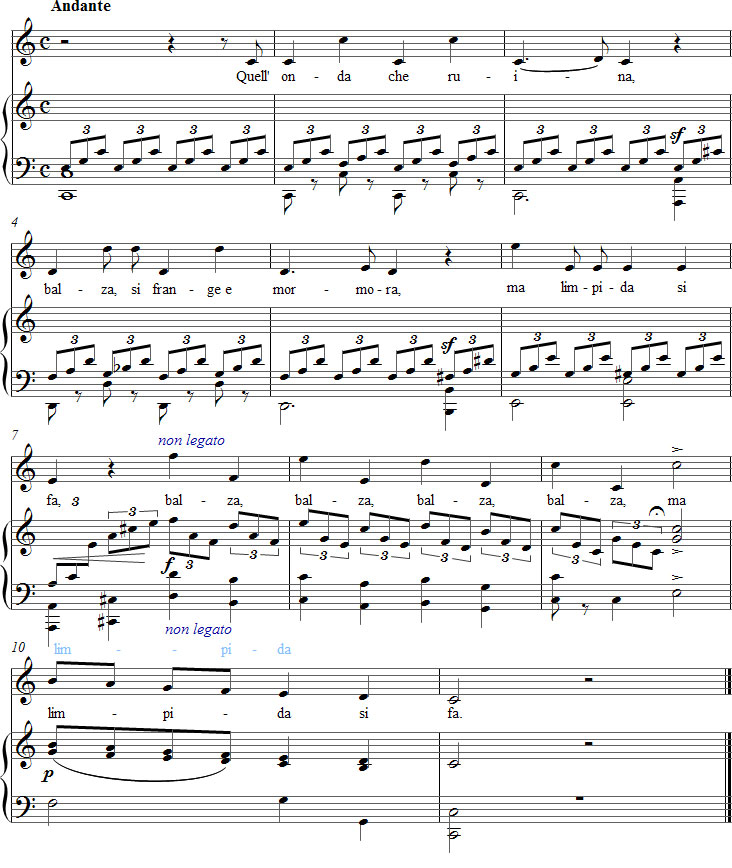
Lyrics
Intervalli di ottava
Octave intervals
splashes, spatters and grumbles
but eventually calms down again.
Performance instructions
This exercise focuses on the octave interval. Vaccaj has chosen a dramatic text for the song and a musical setting of a similar character, marked tempo allegro.
This is the only exercise in Metodo pratico in which the composer does not use all the lines of Metastasio's poem. Vaccaj takes account of the varying stresses in the seven-syllable verse by giving the word Quell' an upbeat, but not the word balza. There are quite a few accents on weak beats in the first two phrases of the song. They are supported by the text's image of surging water, which also motivates the ascending and descending octave leaps essential to the student's practice. Since consecutive stresses are generally avoided in Italian poetry, the word ma, which occurs on the first beat of bar 6, prevents the first syllable of limpida from being stressed.
Because the concluding scale in this exercise is the reverse of the scale that opens Manca sollecita, the first song in the singing method, we may assume that Vaccaj intended to connect the two songs and, at the same time, bring the first part of Metodo pratico to a close.
Practice suggestions
Begin by practising all the octaves as repeated notes at the same pitch. This leaves the following "melody":
do - do - do - do - do - do - re - do
re - re - re - re - re - re - mi - re
mi - mi - mi - mi - mi - mi
fa - fa - mi - mi - re - re - do - do
do2 - si - la - sol - fa - mi - re - do
Make use of the syllables in the first four phrases for energetic articulation, and emphasise them in contrast to the exceptionally close legato of the concluding scale.
Sing the text of the first three phrases with the modified melody as well, and enjoy exaggerating Vaccaj's accents.
Quell'onda che ruina,
balza, si frange e mormora,
ma limpida si fa.
The original melody should also be sung non legato until the concluding scale. (An important exception must naturally be made if there is a risk of a vocally unhealthy register transition for a female student.)
In principle, some of the 13 octave leaps could be filled in with eighth-note triplets using thirds and fifths. In practice, however, this would detract from the composition so much that it is better for the student to sing the relatively easy octave interval directly from the outset, without auxiliary notes.
Ideas for interpretation
In the first four phrases, an ideal performance of the song includes non legato, a lively tempo, a forte dynamic, exaggerated articulation and uninhibited accentuation.
A fermata can be added to the final note of the pianist's second triplet figure in bar 9, allowing the singer enough time to breathe appropriately in preparation for the different character of the final phrase.
The singer and pianist must adapt the accent in bar 9 to the piano dynamic of the penultimate bar.
Other notes
Try singing the syllable -pi- in the penultimate bar on the fourth eighth note.
Forshufvud, G. 1994. Con lieve fiato. Lärarhandledning till Nicola Vaccajs Metodo pratico. Göteborgs universitetet.