Vaccaj: Exercise 7
Listen to the recording
Sheet music
Lyrics
Introduzione alle volate
Introduction to roulades
like the whiteness of virgin snow.
A single mark on it will break its beauty.
Performance instructions
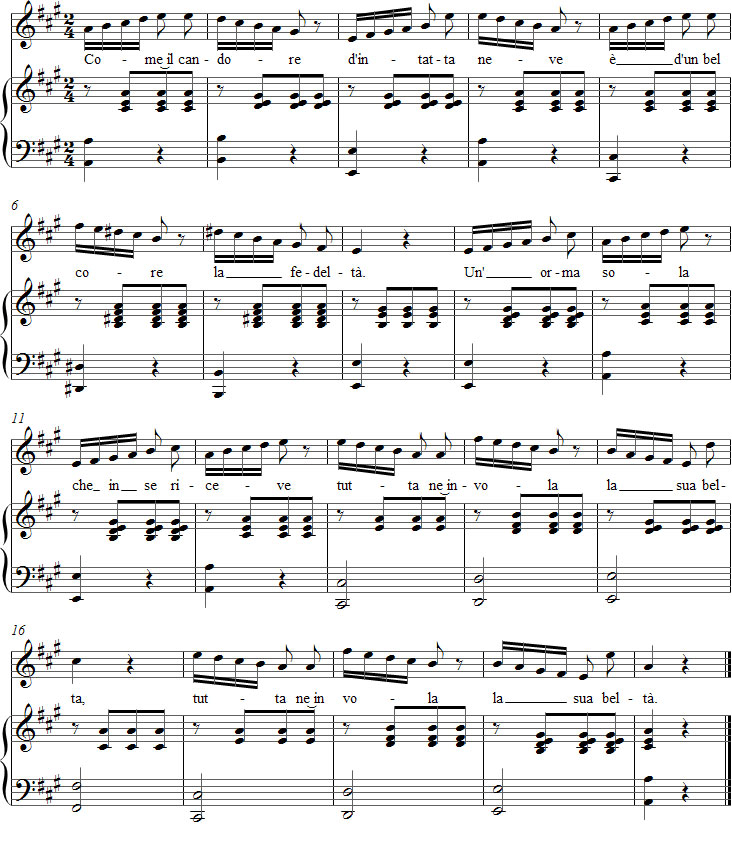
This exercise practises five-note runs (volatine), first at a slow adagio tempo and, as the student's skill develops, at a faster allegro tempo. There are 17 runs in the song altogether. Exercise 7 also serves as a preliminary exercise for rapid runs (volate), which are introduced in Exercise 12. The fact that these two exercises are so far apart may reflect the composer's wish to work on short, rapid scales thoroughly over a long period before moving on to longer scales. Here, coloratura has an expressive function.
Although the exercise is intended to be sung at several different tempos, the musical notation is best suited to tempo allegro.
Come il candore is the first aria text in Metodo pratico that Vaccaj sets to music in its entirety. He uses the prosodic pattern of the poem's first line throughout the aria and thus does not take Metastasio's varying stresses into account. The choice of text may have been influenced by the word candore – sincerity, straightforwardness. It has been suggested that using the so-called "white voice" (voce bianca, voix blanche) helps with fast singing. (The terms voce bianca and voix blanche refer to a colourless voice that is pale in expression, emotionless and cold.)
Practice suggestions
You can imagine the note values as being twice as long in order to get a feel for tempo adagio.
Begin by practising with syllables. Alternate regularly between two different syllables, such as vo-vy, or other combinations that are phonetically close to each other in the same way, such as vi-ve, vi-vo, ve-vö or vo-vu.
Also practise with pure vowels, using staccato on the shorter notes and a lighter marcato on the longer ones. Avoid adding any h sounds, that is, the so-called "horse coloratura" (coloratura alla cavalletta). Instead, following Hiller's approach, think of two slurred and two supported sixteenth notes.
Occasionally sing with pure legato on vowels alone. The aim is to keep the melodic line clear. (Imprecise runs are known as coloratura alla sapone, or "soap coloratura".)
An important intermediate goal is to sing the scales with both legato connection and articulation at the same time.
Gradually begin singing the song with Metastasio's text, using both legato and staccato / marcato.
Continuous work on articulation technique prevents the incorrect, mechanical habit of accenting the first sixteenth note of every figure.
Make a soft, almost indistinct hiatus in bar 1 (in linguistics, particularly in ancient poetry, hiatus refers to two vowels belonging to different words occurring consecutively without elision, that is, without dropping the final vowel of the first word when the following word also begins with a vowel). Che in in bar 11 can be divided into sixteenth notes in groups of 2 + 2 or 3 + 1. No hiatus should be made here either.
Ideas for interpretation
Concentrating on different kinds of articulation must not take precedence over communicating the meaning of the text to the listener. Phrasing bars 1–8 together may help, as may phrasing bars 9–16 (and 17–20) together. If each line of text is also directed towards its final stressed syllable, syllables such as d’in, é, la, etc., will also come across clearly. This also brings out the rhyming pairs candore – core, neve – riceve and fedeltà – beltà.
Forshufvud, G. 1994. Con lieve fiato. Lärarhandledning till Nicola Vaccajs Metodo pratico. Göteborgs universitetet.